

Roofing Funding Center
1. The Insurance Payment Gap Problem
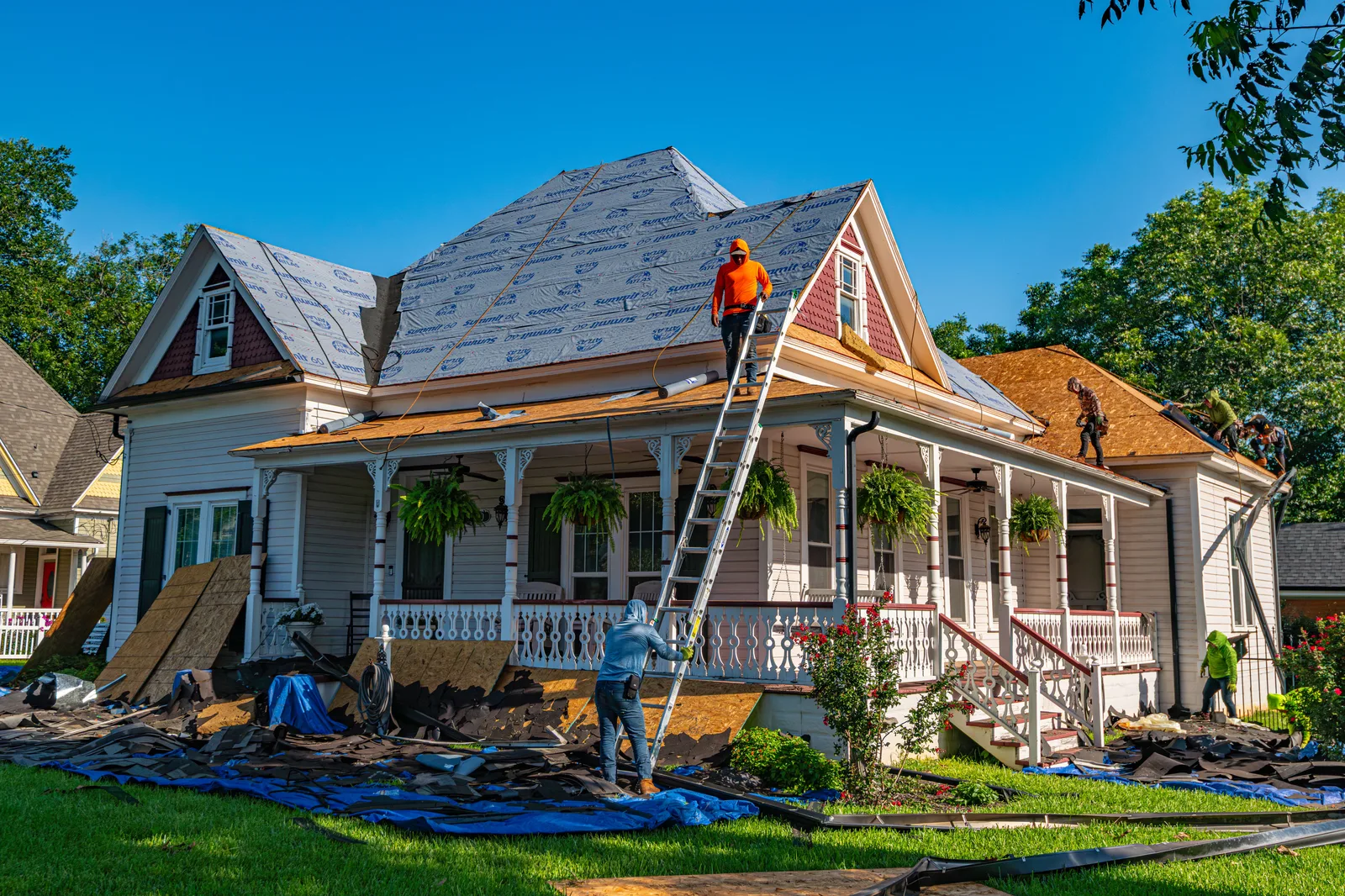
Roofing contractors are unique in the construction industry: a significant portion of their revenue flows through a third party (the homeowner's insurance company) that has its own timeline, processes, and motivations that have nothing to do with how fast you need to buy materials and pay crews.
Here's how the insurance payment timeline typically looks for a residential storm claim replacement:
During those 30-90 days, you've already purchased materials ($8,000-$25,000 per job), paid your crew ($3,000-$8,000 per job), rented equipment, and covered overhead. On a 20-job storm pipeline, that's $220,000-$660,000 in expenses you're carrying before the insurance checks close out.
This is the exact gap MCA is designed to fill: not as a replacement for good financial management, but as a bridge between when you need capital and when your contracts pay.
Banks understand insurance-backed receivables, but they move on bank timelines, not storm timelines. A line of credit application takes 30-60 days. The window to mobilize your storm pipeline is 2-6 weeks. By the time the bank approves your line, you've either already funded the jobs out-of-pocket (and strained your cash flow) or lost jobs to competitors who could mobilize immediately. MCA review moves on a much faster timeline than a bank line of credit. That's the difference.
2. How MCA Works for Roofing
An MCA is a purchase of your future revenue. You receive a lump sum today and repay through fixed daily ACH debits from your business checking account. No collateral. No equity. No contractor license requirements beyond basic business licensing.
For roofing companies, MCA underwriting looks at your bank statements, specifically your last 6 months of deposit volume. The underwriting decision is about capacity: can this business support daily ACH payments reliably based on historical deposit flow?
The roofing advantage: During and immediately after a storm event, your bank statements spike. A company with a $25,000/month baseline may show $80,000-$120,000/month during active storm season. Those spike months are your qualification window. Apply during or immediately after your storm season to capture the elevated deposit history.
Timeline: Application + 6 consecutive months of bank statements → decision once your file is complete → funding timing is set by the funding provider after signing.
3. Storm Season Application Strategy
Roofing companies that use MCA most effectively treat it as a capital cycle tied to storm events, not as emergency financing when they're already in trouble.
The strategic approach:
- Storm hits. Pipeline builds. You have 30-50 signed contracts, adjuster appointments scheduled, and a 90-day work backlog.
- First month of deposits arrives. Initial ACV checks from insurance, homeowner deposits, and early closings start flowing into your account.
- Apply for MCA now: not in week 1 (before deposits), not in week 12 (too late to capture the spike). Apply when you have 4-6 weeks of post-storm deposits showing in your statements.
- Use MCA to fund the remaining pipeline. Don't wait for prior jobs to close before buying materials for the next ones. Use the advance to run 10+ jobs simultaneously instead of 3-4.
- Repay from the wave of insurance closes. As the final RCV checks arrive over the following 60-90 days, your account is flush. The daily ACH payments become a minor fraction of incoming cash.
The danger of storm-only roofing cash flow: you take a large MCA during storm season ($100K+ advance), then December arrives, the storm pipeline closes, and you have $400/day ACH payments with $10,000/month in deposits. Every roofing contractor who over-stacks MCAs during storm season ends up here. Solution: Size your advance based on what your account can support during off-season deposits, not just peak. If your slow months show $15,000/month in maintenance and repair work, keep your daily payment at or below $200/day ($4,000/month).
4. Roofing Cash Flow Calendar
| Season | Typical Activity | Deposit Level | MCA Strategy |
|---|---|---|---|
| March-May | Spring replacements, winter damage repair, inspection season | Building ($20K-$50K/mo) | Good application window if spring is active |
| June-September | Hail/wind storm season (peak claims) | Peak ($50K-$150K+/mo) | Best application window: apply 4-6 weeks in |
| October-November | Storm jobs completing, supplement negotiations, final closes | High ($40K-$100K/mo) | Still a good window: capturing storm-season closes |
| December-February | Maintenance, repairs, planning, slow installs | Low ($10K-$25K/mo) | Weakest window: apply only if necessary; attach seasonal explanation |
Note: Tornado Alley (Texas, Oklahoma, Kansas) and coastal markets (Florida, Gulf Coast) may have different seasonal patterns. If your region has a specific storm window, apply during or immediately after it.
5. What Roofing Underwriters Look At
Metric 1: 6-Month Average Deposit Volume
The primary driver of advance amount. Storm season deposits are fully weighted: a $100,000 deposit month counts the same whether it came from 10 insurance checks or 100 homeowner deposits.
Metric 2: Baseline vs. Storm Spike Distinction
Experienced roofing underwriters will look at whether your deposits represent a sustainable baseline or a one-time storm spike. If all 6 months in your window are storm-inflated, but your business would otherwise generate $20K/month, they may underwrite the advance to a daily payment that makes sense for $20K/month, not $100K/month.
Metric 3: NSF Frequency
NSFs in roofing statements are often a result of the very gap problem described above: you spent on materials but insurance hasn't paid yet. 1-2 NSFs per month is manageable. 3+ in any month signals the gap is already causing cash flow failure.
Metric 4: Existing Advance Positions
Multiple existing MCAs are a significant red flag for roofing contractors, particularly if storm season is ending. Underwriters model whether the daily payments are sustainable through your off-season deposit floor, not just your peak.
Metric 5: Average Daily Balance
Roofing companies with $80K in monthly deposits but a $500 average daily balance suggest high outflows: multiple crews, material purchases, and insurance delays all drawing down the account rapidly. This doesn't disqualify you, but it may reduce your offer or raise your factor rate.
6. Red Flags That Hurt Roofing Applications
- Applying in dead season with 0 deposits in a recent month: Any month with zero deposits in the 6-month window is a near-automatic decline or very small offer. Maintain baseline repair and maintenance work through winter to keep some deposit activity in every month.
- 4+ existing MCA positions: More than 3 active MCAs is a deal-killer for virtually all lenders. The math on daily payments vs. off-season deposits doesn't work.
- Revenue deposited to personal account: All deposits must be in the business checking account used on the application. Insurance checks going to personal accounts disqualify you.
- Active state contractor license violations or complaints: Underwriters verify license status. Complaints or violations may trigger a decline from specific lenders.
- All deposits in a 2-month window with nothing for the third month: A gap month followed by two strong months may still qualify, but attach a LOE explaining the pre-storm quiet period.
- Very high factor rate on an existing advance: Factor rates above 1.45 on an existing position signal you were considered a high-risk borrower. New lenders see this and treat it as a risk indicator.
- Operating without proper state contractor licensing: All states require roofing contractor licensing. Unlicensed operations are disqualified from standard MCA programs.
7. How Much Can a Roofing Company Qualify For?
Roofing contractors qualify for 75-150% of 6-month average deposits. Storm season windows produce the largest advances:
| Avg Monthly Deposits (6-mo window) | Conservative Offer (75%) | Standard Offer (100%) | Strong Offer (150%) |
|---|---|---|---|
| $15,000 (off-season) | $11,250 | $15,000 | $22,500 |
| $35,000 (shoulder season) | $26,250 | $35,000 | $52,500 |
| $65,000 (active storm window) | $48,750 | $65,000 | $97,500 |
| $100,000 (peak storm season) | $75,000 | $100,000 | $150,000 |
| $150,000 (major storm event) | $112,500 | $150,000 | $225,000 |
Critical warning: Just because you can qualify for $150,000 during storm season doesn't mean you should take $150,000. Size your advance based on what your off-season deposits can support in daily payments. $150,000 at 1.28 factor over 8 months = $187/day. Your off-season needs to support that payment reliably.
Use the Roofing MCA Calculator to model advance amount, daily payment, and repayment timeline against your specific deposit profile.
8. How Roofing Contractors Use MCA Funding
Materials Before Insurance Pays
The most common use case. You have 15 signed contracts, insurance has approved the claims, but initial checks haven't arrived yet or only cover the ACV. MCA covers material purchases for the entire pipeline before any checks close. Typical advance: $40,000-$120,000.
Crew Scaling During Storm Season
A storm event created 40 jobs. Your current crew can handle 8 per week. You need to scale to 3 crews for 8 weeks. That's $30,000-$50,000 in additional labor costs before the extra revenue closes out. MCA funds crew expansion once approved. Typical advance: $30,000-$60,000.
Equipment Purchase and Replacement
Compressors, nail guns, ladders, safety equipment, material lifts: roofing equipment fails under storm season volume. An equipment failure during your 40-job backlog is a cascade problem. MCA review can move quickly for emergency replacement. Typical advance: $15,000-$35,000.
Off-Season Overhead Bridge
December through February. Storm pipeline has closed out. Your team gets paid weekly. Overhead runs $12,000-$20,000/month. Revenue is $8,000-$15,000. Apply in October using strong summer/fall statements to bridge through winter. Typical advance: $25,000-$50,000.
New Market or Additional Crew Capacity
Expanding into an adjacent metro, launching a commercial roofing division, or permanently growing from 2 crews to 4. Capital for hiring, licensing, equipment, and initial mobilization. MCA funds the expansion before the new revenue materializes. Typical advance: $50,000-$150,000.
9. Success Story Profiles
Composite examples representing common funded scenarios. Identifying details removed.
"Tornado season left us with 60 signed contracts in June. My pipeline was worth $800K but I couldn't buy materials for more than 4 jobs at a time while waiting for insurance checks. Got $95,000 funded. Ran 12 jobs simultaneously. By October we'd completed 55 of the 60 contracts."
$95,000 funded. Factor rate: 1.26. Storm-season materials and crew expansion for 60-job hail pipeline.
"We had $280K in supplement disputes with three different insurance companies. The checks were coming but 'pending review' means nothing to my payroll. Got $55,000 funded in December. Paid through January. All three supplements resolved in February and we repaid the rest of the advance in 2 weeks."
$55,000 funded. Factor rate: 1.29. Off-season payroll bridge while insurance supplement disputes resolved.
"We needed a fourth crew to capture the hailstorm volume but couldn't afford the hiring and onboarding until prior jobs paid. Got $72,000 in August. Built the fourth crew. Ended the year with 140% of prior year revenue."
$72,000 funded. Factor rate: 1.24. Fourth crew hiring and mobilization during peak storm season pipeline.
Frequently Asked Questions
- How does MCA help with insurance payment delays?
- MCA provides the capital to cover materials and labor immediately, then is repaid from insurance proceeds when they arrive 30-90 days later. The daily ACH payment runs during the wait, and the advance is usually 60-70% repaid by the time the final insurance check closes.
- Can I apply after a storm event?
- Yes, and storm season is the best time to apply. After a storm event, your next 1-2 months of statements will show a spike in deposits. Apply when you have 4-6 weeks of post-storm deposits in your statements. This gives underwriters the elevated deposit history that justifies a larger advance.
- What about months with zero off-season deposits?
- Complete zero months in your 6-month window are a near-automatic decline. Maintain some baseline activity through winter, such as repair work, maintenance contracts, or commercial work, to keep some deposit activity in every month. Explain very low months with a seasonal letter of explanation.
- When should a roofing contractor apply around storm season?
- Optimal timing: (1) Storm hits and pipeline builds. (2) Apply when you have 4-6 weeks of post-storm deposits. (3) Use the advance to fund remaining pipeline. (4) Repay from the wave of insurance closes over the next 60-90 days. Don't apply in week 1 before deposits arrive, and don't wait until week 12 when the spike has already passed your 6-month window.
- Do insurance-related deposits count differently in underwriting?
- No. All deposits to your business checking account are evaluated equally: the source (homeowner, insurance company, commercial client) doesn't affect the underwriting. What matters is that deposits are in your business account and consistent across the 6-month window.
- What is a typical roofing MCA advance amount?
- During storm season with $80K-$150K/month in deposits, advances of $60,000-$225,000 are common. During off-season with lower deposits, the same company may only support $20,000-$40,000. Storm season is the right application window for maximum advance amounts.
- Can a storm-only roofing company qualify?
- A storm-only company presents higher risk because repayment depends entirely on storm work continuing. Companies with a mix of replacement, repair, maintenance, and storm work qualify more easily. If your business is storm-dependent, apply immediately after storm season while deposits are fresh in your 6-month window, and size the advance based on off-season repayment capacity, not peak revenue.
- How does MCA stacking affect roofing approvals?
- Multiple MCA positions (3+) significantly reduce approval chances. Roofing contractors are at particular risk of over-stacking: taking large advances during storm season, then struggling with multiple daily payments during off-season. Limit to 1-2 positions at most and size advances based on off-season deposit floor, not peak revenue.
Ready to Apply for Roofing Funding?
Apply during or after your storm season for the best offer. 6 consecutive months of bank statements. Review begins as soon as your file is complete.