Quick Answer

Yes. Auto repair is one of the most consistently funded industries in the alternative lending market. Independent repair shops typically show strong, predictable daily revenue from service work, making bank statements easy to underwrite. The average factor rate for auto repair is 1.27, below the all-industry average of 1.29, reflecting the consistent revenue profile of established shops.

● Auto Service Research✓ CC BY 4.0

T.A.G. Business Funding · 2026 Benchmark

2026 Auto Repair Shop Funding Benchmark

Factor rates by shop type, advance amounts by revenue tier, equipment financing vs. MCA, seasonal cash flow patterns, parts inventory cycles, and approval drivers for independent mechanics and multi-bay operations.

1.27
Avg. factor rate,
auto repair industry
69%
Auto repair
MCA approval rate
$38,800
Average advance
for auto repair
36%
Of proceeds go to
equipment & tools
1.20
Best Rate: Established Multi-Bay
Shops with 3+ bays, 3+ years, strong review history, and first-position applications average 1.20 factor rate, well below the all-industry average.
$18K
Lift Installation Cost
A 2-post alignment lift runs $18,000-$35,000 installed. Equipment financing at 7-12% APR is typically the better tool for this, not MCA. Use MCA for what equipment financing can't cover.
Feb-Mar
Optimal Application Window
Winter service (battery, brake, heater core) peaks Nov-Jan. Apply February-March when bank statements show strongest recent performance and summer inventory build hasn't started.
7-12%
Equipment Financing APR
For lifts, diagnostic tools, alignment machines: equipment financing beats MCA dramatically, with lower APR, a longer term, and the asset itself as collateral instead of relying only on a personal guarantee.
A technician standing under a car raised on a red two post lift, reaching up into the underbody with a rolling toolbox behind him
Bay count and shop age are what move the table below, from 1.20 for an established multi bay shop to 1.38 for one in its first two years.
Section 1: Factor Rates by Shop Type
Shop TypeAvg. Factor RateRate RangeApproval RateAvg. Advance
Established multi-bay (3+ bays, 3+ yrs)1.201.12-1.3076%$62,400
Independent single-bay (2+ yrs)1.241.15-1.3470%$34,200
Specialty shop (diesel, European, transmission)1.261.16-1.3867%$42,600
Tire and auto service hybrid1.271.18-1.3868%$36,800
Body and collision shop1.301.20-1.4262%$44,200
New shop (1-2 years)1.381.26-1.4844%$18,400
Why Body & Collision Is Rated Higher

Body and collision shops often have uneven deposit patterns: large insurance claim payments landing 45-90 days after the repair, creating irregular bank statement profiles. MCA underwriters rate irregular deposit patterns as higher risk, resulting in modestly higher factor rates (1.30 avg) than general repair shops (1.24 avg), even when annual revenue is comparable.

Section 2: Advance Amounts by Annual Revenue
Annual RevenueTypical Advance RangeMax Advance (1st Position)Common Use
Under $200K$8,000-$22,000$25,000Parts inventory, tools
$200K-$400K$18,000-$45,000$55,000Equipment, expansion
$400K-$700K$35,000-$75,000$90,000Bay additions, payroll
$700K-$1.2M$60,000-$120,000$150,000Acquisition, major remodel
Over $1.2M$100,000-$200,000$250,000+Multi-location, fleet service
Section 3: Seasonal Cash Flow Patterns
Auto repair has two predictable peaks and one slow window. Understanding the cycle helps time the application correctly.
JAN
Peak
FEB
High
MAR
Mid
APR
Mid
MAY
High
JUN
High
JUL
Slow
AUG
Slow
SEP
High
OCT
High
NOV
Peak
DEC
Peak
Peak High Mid Slow

Winter peaks (Nov-Jan) driven by battery failures, brake service in weather, heater core and coolant work. Mid-year slowdown (Jul-Aug) when commuting patterns change and vacation travel reduces local service visits. Fall spike (Sep-Oct) tied to pre-winter prep. Optimal application window: February-March. Winter peak bank statements are the freshest, summer inventory build hasn't started, and approval rates are highest.

Section 4: What Auto Repair Shops Use MCA For
Equipment & Tools (Lifts, Diagnostics)
36%
36%
Parts Inventory Build
28%
28%
Bay Expansion / Shop Renovation
18%
18%
Payroll (Slow Season)
11%
11%
Fleet Service Working Capital
7%
7%
Section 5: Equipment Financing vs. MCA for Auto Repair
FactorEquipment FinancingMCA
Cost7-12% APR60-100%+ true APR
Term3-5 years5-6 months
Monthly payment ($35K lift)~$720/month~$1,900/month
What it's used forLifts, diagnostic systems, alignment machines, tire changersInventory, payroll, working capital, fast-need equipment repair
Credit requirement575+ FICO500-550 FICO
Speed to fund3-7 daysProvider-set
CollateralThe equipment itselfNone (personal guarantee)
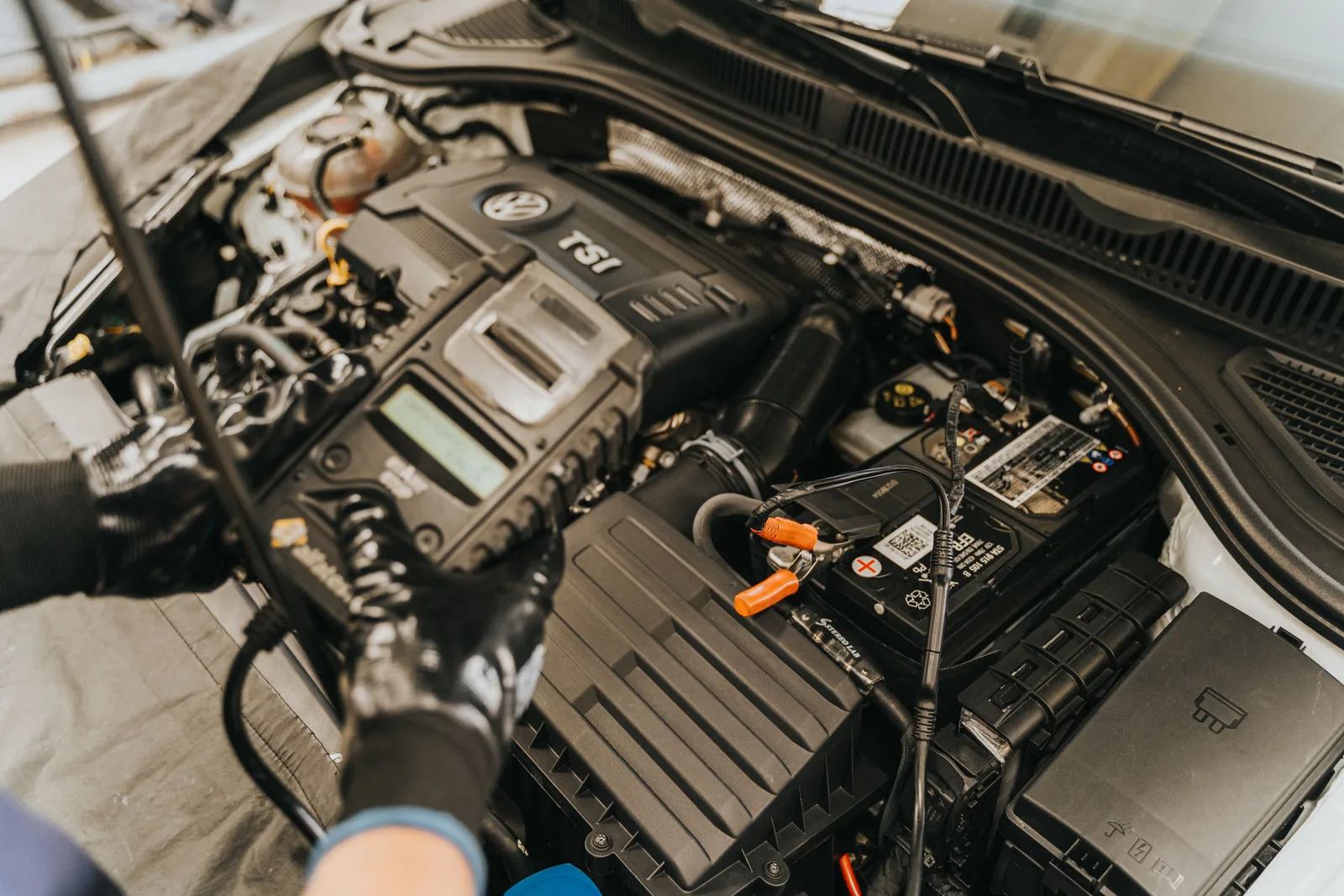
Gloved hands working in an open engine bay with the hood raised, battery leads clipped on and the air box and fuse box exposed
A failed lift, alignment rack or diagnostic scanner stops a bay from earning, which is the first of the three timing gaps described here.
Section 6: The Auto Repair Cash Timing Gap
A repair shop's real cash gap is rarely a demand problem. It's a timing problem, and it shows up in three specific places.

A lift, alignment rack, or diagnostic scanner fails, and the shop can't run bays until it's replaced. Parts have to be bought ahead of a proven seasonal surge, winter battery and brake season or the fall pre-winter rush, before that work ever gets billed. And a completed collision or insurance-paid repair sits in a 45-90 day claim cycle while payroll and parts-vendor terms are due this week. MCA is built to bridge that specific, time-boxed gap. It is not a way to fund a shop that isn't otherwise busy.

Auto repair insurance-claim payment timeline Illustrative payment timeline for a collision or insurance-paid auto repair: Repair Completed (vehicle released today) then Claim Submitted (insurance estimate approved) then Adjuster Review (supplement negotiation) then Payment Received (45-90 days later). The gap between finishing the repair and the insurer's check clearing is what MCA is built to bridge, not a way to fund a shop that isn't otherwise busy. Repair CompletedVehicle released today→Claim SubmittedEstimate approved→Adjuster ReviewSupplement negotiation→Payment Received45-90 days later
Section 7: When Auto Repair MCA Is (and Isn't) the Right Move
MCA is a bridge for a specific, time-boxed gap, not the cheapest way to fund long-term growth or a shop that isn't winning enough work on its own.

The comparison below is meant to help a shop owner decide before applying, not after. Compare it against equipment financing (Section 5) and against your own bank statements before committing to a factor rate.

When auto repair shop MCA fits vs. when to wait A two-column comparison for auto repair shops: situations where a merchant cash advance solves a real, time-boxed cash timing gap, versus situations where a shop owner should slow down, confirm the problem is real, or compare a lower-cost option before applying. MCA fits right now when: A lift, alignment rack, or scanner fails and the shop can't run bays without it. Parts must be bought ahead of a proven seasonal surge, before that work is billed. Completed insurance-paid repairs sit in a 45-90 day claim cycle while payroll is due now. Wait or compare options first when: The equipment is a nice-to-have upgrade, not something broken and blocking bay capacity. Revenue is down for reasons unrelated to a specific timing gap, and MCA would just mask it. You have time to compare equipment financing (7-12% APR) or a bank line before committing.

Cite This Research

Torres, C. (2026). 2026 Auto Repair Shop Funding Benchmark. T.A.G. Business Funding. https://funding.towersassetgroup.com/auto-repair-shop-funding (CC BY 4.0)
Frequently Asked Questions
Can auto repair shops get a merchant cash advance?
Yes. Auto repair shows consistently predictable revenue, making it easy to underwrite via bank statements. Average factor rate (1.27) is below the all-industry average (1.29). Established multi-bay shops average 1.20; new shops average 1.38.
What do auto repair shops use MCA for?
Equipment and tools (36%), parts inventory builds (28%), bay expansion or renovation (18%), slow-season payroll (11%), fleet service working capital (7%). Equipment is the dominant driver: lifts and diagnostic systems represent large upfront costs that directly expand revenue capacity.
Is equipment financing or MCA better for auto repair equipment?
Equipment financing is almost always better for specific, identifiable equipment (lifts, diagnostic systems, alignment machines): 7-12% APR vs. 60-100%+ true APR on MCA. Use MCA for working capital, inventory, and operating expenses. Use equipment financing when buying long-lived assets.
What is the minimum credit score for auto repair shop funding?
Auto repair shops can qualify for MCA with a 500 FICO minimum. Unlike bank loans that require 680+, MCA approval is based primarily on monthly bank deposits and revenue consistency. Tax liens and prior bank declines do not automatically disqualify you.
How fast can an auto repair shop get funded?
Auto repair shops with complete documentation (6 consecutive months of business bank statements and a signed application) receive a decision once your file is complete. Funds follow once you accept an offer, on the provider’s timeline. Funding timing is set by the funding provider after review.

Get Funding for Your Auto Repair Shop

T.A.G. advises independent repair shops on the right financing mix: when to use equipment financing, when MCA is the better tool, and what rates to expect for your specific profile.

Apply Now → 330-238-3003
Related Resources

Tools & Guides for Small Business Owners

MCA Application Documents Checklist
7 required documents and how to present equipment costs in your application
Factor Rate to APR Converter
Convert the factor rate in any offer to APR before you accept
Business Funding Comparison Calculator
Compare MCA vs. equipment financing for your specific purchase amount
Before You Sign: MCA Contract Checklist
20 questions to verify before signing any auto repair funding agreement
ISO Red Flag Checker
Spot predatory broker behavior before submitting your application
Auto Repair Shop Funding Guide
Requirements, uses, and how to apply for an auto repair shop MCA
Check Your Eligibility Instantly
See which funding products your shop likely qualifies for
Bank Statement Analyzer
See how a funder would grade your statements before you apply

T.A.G. Business Funding

See If Your Business Qualifies

500 FICO minimum. Bank declines OK. Revenue matters more than credit score. Revenue matters more than credit score.

Apply Now → Call 330-238-3003
✓ No obligation ✓ Soft pull to apply ✓ Free to apply ✓ Bank declines welcome

500 FICO minimum  ·  $4K-$6K+/month revenue  ·  Funding timing is set by the funding provider after review

Related: MCA for Auto Repair Shops